Settlement of Anarres
The DispossessedThe Settlement of Anarres was the migration of a million Odonians from Urras to the Moon and the founding of a society organized around Odo’s anti-authoritarian principles. It began as a political concession intended to contain the Odonian challenge to law and national sovereignty, but became a lived experiment in decentralized cooperation: one that carried its ideals across a dry abyss while binding the new society to a closed border and a difficult ecology.
Political Origins and Migration
Anarres had been explored and mined before it was settled. The Urrasti year IX-738 saw a mining settlement founded at the foot of the Ne Theras Mountains, where mercury was extracted in the old Ans Hos region. Called Anarres Town, it was a temporary work camp rather than a permanent community: men signed on for two or three years and then returned to what they regarded as the real world. Separately, Thu maintained a secret rocket base and a settlement of goldminers with their families in the Moon’s eastern hemisphere. When Thu’s government collapsed in 771, the Council of World Governments proposed giving the Moon to the International Society of Odonians. The transfer was meant to buy off a movement that threatened the authority of law and national sovereignty on Urras. Anarres Town was evacuated, and rockets sent amid the turmoil in Thu retrieved the goldminers, though some chose to remain on the Moon.
Over more than twenty years, twelve ships granted by the Council carried the Odonians across the interplanetary distance. The migration brought a million people who chose the new life; when it was complete, immigration ended and the port remained open only to freight ships operating under the Trade Agreement. The former Anarres Town had grown to a hundred thousand people and was renamed Abbenay, meaning Mind in the new language. The scale and duration of the crossing make the Settlement both a political departure from Urras and the material beginning of a new social order.
An Ideal of Decentralized Society
Odo’s plans rejected a controlling center, a capital, and the bureaucratic machinery through which individuals might become bosses or state leaders. She did not propose dismantling urban civilization. Instead, she envisioned connected communities linked by communication and transportation, allowing goods and ideas to reach where they were wanted without a hierarchy directing the network from above. Communities were to have a natural limit set by dependence on their immediate regions for essential food and power, yet remain open to interchange rather than isolated from change.
Anarres made that ideal harder to realize. Its aridity forced communities to spread widely in search of resources, and few could support themselves, even after residents sharply reduced their expectations of what counted as necessary. The settlers refused a return to pre-urban, pre-technological tribal life: they understood their anarchism as dependent on advanced technology, high production, and rapid transport. They built roads before houses, then relied on continuous exchange among regions with different resources and products. The intended result was not self-sufficiency everywhere but an intricate balance of diversity, a social ecology held together without a central authority.
Ecological Limits and Collective Work
The Moon’s ecology set severe limits on what the settlers could bring or sustain. Anarres had abundant marine life, but on land its sparse plants and limited animal life reflected a long climate of dust and dryness. Human settlement depended on careful adaptation: fishing without exhausting the seas, cultivation, and the use of organic waste as fertilizer. There was no grass to support herbivores and therefore no basis for carnivores; flowering plants lacked insect pollinators, so imported fruit trees had to be fertilized by hand. Animals were not introduced from Urras for fear of upsetting the delicate balance, and the settlers arrived scrubbed well enough to bring very little of their own flora and fauna.
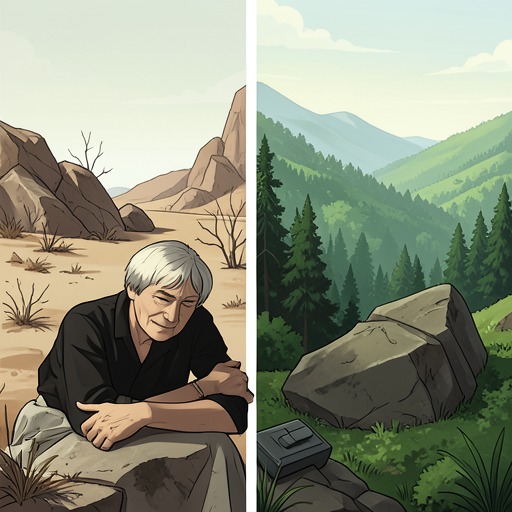
The history of the Dust gives that scarcity a longer timescale. In an earlier geological era, the region had been covered by holum forest. A hotter, drier climate and millennia of drought killed the trees and reduced the soil to fine grey dust, which winds shaped into barren hills. The settlers hoped to restore fertility by replanting the forest. The afforestation of the West Temaenian Littoral later became one of the Settlement’s major undertakings, employing nearly eighteen thousand people for two years. Its effort joined practical work to a wider Odonian aspiration: to reverse, through collective labor, damage that had accumulated over geological time.
Culture, Memory, and Closure
The settlers’ break with Urras was also an effort to make a new culture. They adopted made-up names and learned a made-up language; one account describes them as romantic, while the society that followed is characterized as pragmatic. Their first attempts to create poetry in the new language were described as stiff and ungainly, yet moving. A poem written by Pio Atean, who took the Pravic name Tober, in the Settlement’s fourteenth year preserves the hesitant emergence of that new expressive life.
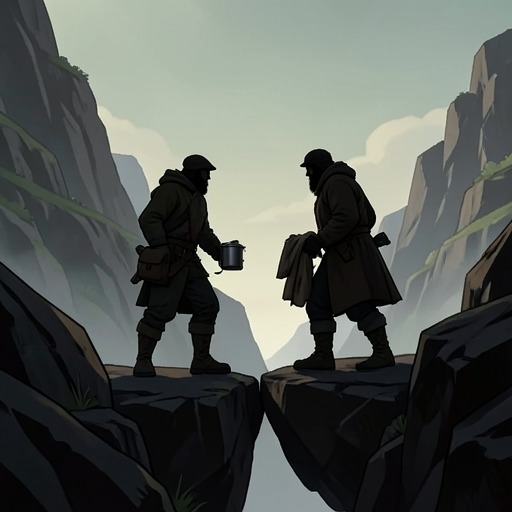
The settlement’s founding did not erase the danger of renewed dependence or political control. Its terms barred Urrasti from going beyond the boundary of the port, a restriction later defended as the safeguard of the experiment against outsiders and possible re-enslavement. The rule also meant that the boundary could be interpreted to bar return by an Anarresti who had left. Decades later, Shevek questioned the assumption that the terms applied to every foreigner, reasoning that the original prohibition addressed Urrasti and that extending it to other peoples merely built more walls. His challenge exposes the Settlement’s lasting contradiction: its separation protected the society from outside domination, yet could harden into isolation that restricted contact and individual choice.
Significance
The Settlement is the founding act behind Anarres’s experiment in nonauthoritarian communism, but the story presents it neither as a simple escape nor as a completed solution. Its origins lie in a strategic bargain by governments seeking to contain Odonian influence; its achievement lies in making a functioning society across an inhospitable world through transportation, regional exchange, and shared labor. Its vulnerability lies in the same conditions that shaped it: ecological scarcity, dependence on coordination, and a closed border justified as protection.
The migration therefore remains an active political question rather than a settled historical episode. Anarres’s principles depend on connection and voluntary cooperation, while its founding terms enforce separation from Urras. That tension—between a society’s defense of its independence and the walls that may confine it—gives the Settlement its continuing significance in the novel.